


The Smart Way to Water: Understanding Underground Systems
An underground grass watering system is a subsurface irrigation method that delivers water directly to grass roots, significantly reducing water waste while promoting healthier lawns.
Quick Guide to Underground Grass Watering Systems:
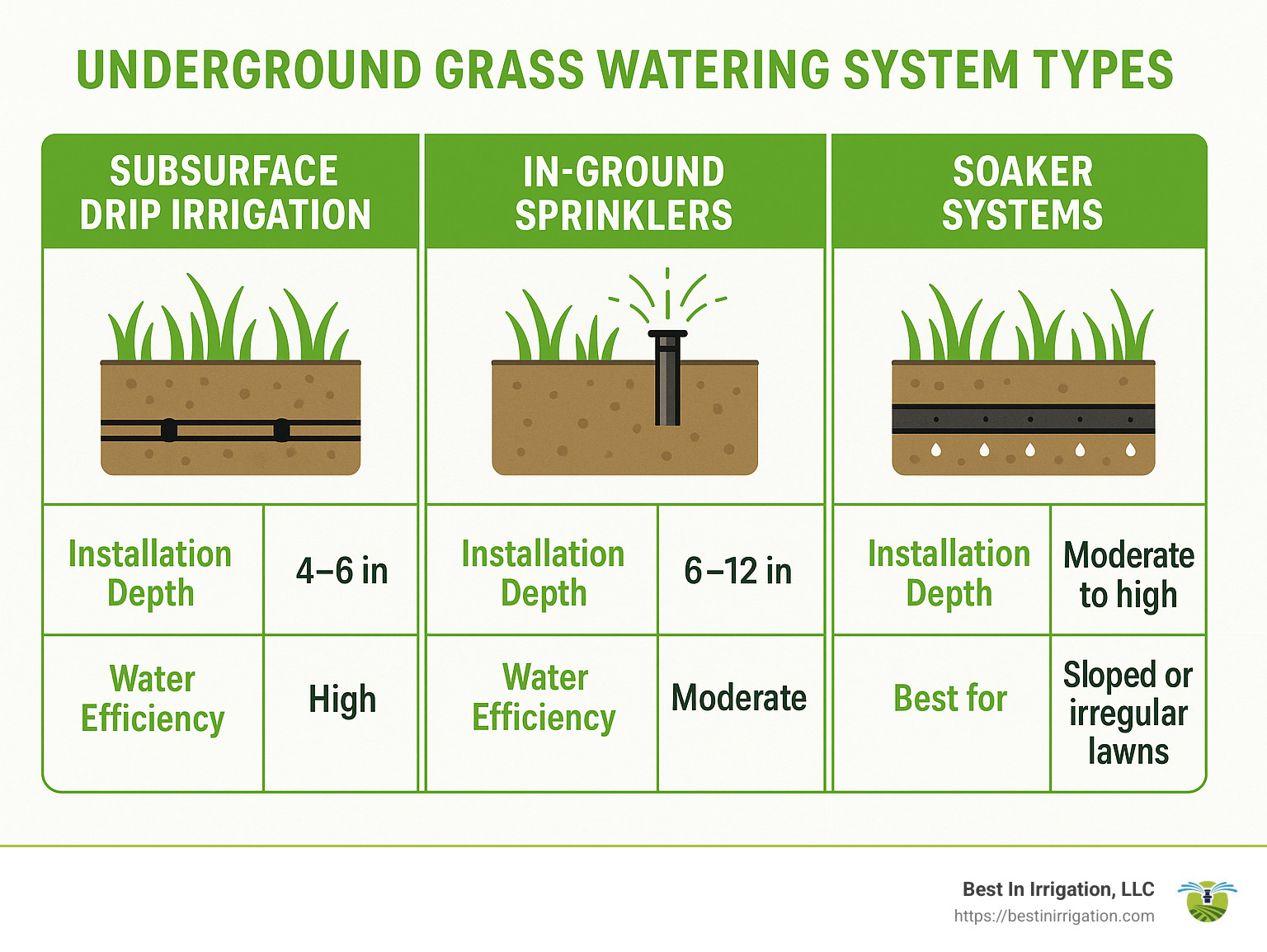
- Subsurface Drip Irrigation (SDI): Delivers water directly to roots via buried tubes with emitters
- In-Ground Sprinkler Systems: Uses buried pipes with pop-up sprinkler heads
- Soaker Systems: Porous hoses that seep water slowly underground
- Typical Water Savings: 50-90% compared to traditional watering methods
- Installation Depth: Usually 6-12 inches below ground
If you’re tired of dragging hoses across your lawn or watching water evaporate before it reaches the roots, an underground grass watering system might be the solution you’re looking for. These systems work by delivering water directly to the root zone, where plants need it most, rather than spraying it on the surface where much of it is lost to evaporation or runoff.
“Installing an underground sprinkler is a great way to conserve water and save money on irrigation,” says an irrigation specialist. This efficiency is especially important in Massachusetts, where seasonal water restrictions can make maintaining a lush lawn challenging.
Underground watering systems come in several varieties, each with its own benefits. Subsurface drip irrigation (SDI) is often considered the most efficient, using up to 70% less water than traditional methods. In-ground sprinkler systems offer excellent coverage for larger lawns, while soaker systems provide a simpler alternative for smaller areas or garden beds.
By delivering water directly to the roots, these systems not only conserve water but also promote deeper root growth, resulting in healthier, more drought-resistant lawns. They also eliminate the eyesore of visible sprinklers and hoses, creating a cleaner landscape aesthetic.
Terms related to underground grass watering system:
Understanding Underground Grass Watering Systems
Ever wondered what’s happening beneath those lush, green lawns that seem to thrive even during water restrictions? The secret lies underground! Underground grass watering systems deliver moisture directly where your grass needs it most—at the root level—making them the smart choice for today’s water-conscious homeowner.
These hidden heroes of modern lawn care represent a significant leap forward from the days of dragging hoses across your yard or setting up sprinklers that water everything except your lawn. In Massachusetts, where our seasonal changes can bring both drought and downpours, these systems offer a consistent, efficient approach to keeping your grass healthy year-round.
According to Merriam-Webster, subsurface irrigation refers to “irrigation below the surface (as by a periodic rise of the water table or by a system of underground porous pipes).” But what does this mean for your lawn? In simple terms, it means healthier grass with less water waste.
Research published in the Journal of Crop and Soil Science has shown that SDI-irrigated turf maintains excellent quality while using significantly less water than traditional methods. As water conservation becomes increasingly important in our region, this efficiency matters more than ever.
Here at Best In Irrigation, we’ve watched countless Massachusetts homeowners transform their lawns with our Lawn Sprinkler Systems. The results speak for themselves: greener grass, lower water bills, and less time spent worrying about watering schedules.
How Underground Grass Watering Systems Work
Think of an underground grass watering system as your lawn’s personal hydration coach, delivering exactly what it needs, when it needs it, without any waste. Here’s how this magic happens:
Water begins its journey from your home’s water supply, traveling through a network of underground pipes or tubes. Before reaching your lawn, it passes through a pressure regulator that brings your household water pressure (typically 30-70 psi) down to the gentler 8-15 psi that’s ideal for subsurface systems.
The star players in this system are the emitters—small devices that release water drop by drop directly into the soil. These are strategically placed every 8-24 inches to ensure even coverage across your entire lawn.
Once released, water moves through the soil via capillary action—nature’s way of distributing moisture through small spaces. Your grass roots, sensing this available moisture, absorb exactly what they need while developing deeper, stronger networks that make your lawn more resilient to drought.
“Since roots are a plant’s organ specially designed to soak up essential water and minerals – traditional water misses the point,” as one irrigation expert puts it. This highlights why these systems are fundamentally more efficient—they deliver water directly to where plants can use it, rather than spraying it on the surface where much of it evaporates or runs off.
The beauty of this process is its precision. There’s no wasted water, no puddles on your driveway, and no wet shoes as you cross your lawn after watering. Just healthy, vibrant grass that makes your neighbors wonder what your secret might be.
Types of Underground Grass Watering Systems for Residential Lawns
When it comes to choosing an underground grass watering system for your Massachusetts home, you’ve got options. Let’s explore the main types so you can decide which is right for your lawn:
Subsurface Drip Irrigation (SDI) represents the gold standard in water efficiency. These systems use flexible polyethylene tubing with built-in emitters that release water directly to your grass roots. Installed 6-12 inches below the surface with emitters spaced 8-24 inches apart (depending on your soil type), SDI systems can save an impressive 50-90% of water compared to traditional methods. They’re perfect for irregularly shaped lawns and sloped areas, and once installed, they’re completely invisible.
In-Ground Sprinkler Systems use buried pipes connected to pop-up sprinkler heads that rise when activated and disappear when not in use. These systems provide excellent coverage for larger lawns and can be zoned to address different areas with varying water needs. While more visible than drip systems when operating, they remain hidden most of the time, maintaining your lawn’s clean appearance.
Soaker Systems offer a simpler approach with porous hoses that allow water to seep out along their entire length. They’re easier to install than other underground options and work well for smaller areas or as part of a hybrid system. While not as precise as SDI, they’re still significantly more efficient than surface watering methods.
Root Quenchers are specialized devices installed next to specific plants to deliver water directly to their root systems. They’re ideal for targeted watering of trees and larger plants within your landscape and can complement your main lawn irrigation system beautifully.
Choosing the right system depends on several factors unique to your property: lawn size and shape, soil type, water conservation goals, and budget. At Best In Irrigation, we specialize in helping Massachusetts homeowners find their perfect match, whether that’s an Automatic Grass Watering System for hands-off convenience or a custom solution for challenging landscapes.
The best system is one that meets your specific needs while conserving water—a win for both your lawn and the environment. And isn’t that what smart lawn care is all about?
Benefits of Installing an Underground Grass Watering System
When it comes to modern lawn care, an underground grass watering system offers benefits that go far beyond just saving you from dragging hoses around your yard. These innovative systems represent a genuine leap forward in how we care for our lawns in Massachusetts and beyond.
Think about what happens when you water your lawn with a traditional sprinkler. Much of that water never reaches the grass roots—it evaporates in the summer heat, runs off into storm drains, or creates puddles in low spots. Underground systems solve these problems by delivering water directly where plants need it most.
Research consistently shows that underground watering systems can reduce water usage by an impressive 50-90% compared to traditional methods. By eliminating evaporation, runoff, and overspray, your lawn gets precisely the water it needs—no more, no less.
But water savings is just the beginning. When water reaches the root zone directly, grass develops deeper, stronger roots. This creates a more resilient lawn that stands up better to drought conditions and actually requires less maintenance over time. The consistent moisture distribution also helps avoid those frustrating patchy areas that some homeowners humorously call “a pepperoni pizza of wet and dry spots.”
There’s another benefit many homeowners don’t consider until they experience it: weed reduction. Traditional sprinklers water everything—including weed seeds on the soil surface. Underground grass watering systems keep the surface relatively dry while maintaining perfect moisture below, naturally discouraging many common weeds from germinating.
As detailed in Subsurface Drip Irrigation – The Most Sustainable Way To Water, these systems represent the gold standard in sustainable lawn irrigation.
Water Conservation and Cost Savings
In Massachusetts, where seasonal water restrictions are becoming increasingly common, the water conservation benefits of an underground grass watering system translate directly into real dollar savings.
Most homeowners see a dramatic 50-90% reduction in their irrigation water usage after installation. This remarkable efficiency comes from several factors working together:
Water goes straight to the roots, so almost none is lost to evaporation. There’s no runoff flowing uselessly down your driveway. Smart controllers adjust watering based on actual conditions rather than rigid schedules. And properly zoned systems apply water only where it’s needed, at exactly the right amounts.
Some homeowners report significant drops in their water bills during the first season of operation. And with Massachusetts water rates continuing to rise, many find that the system pays for itself faster than expected.
Beyond the immediate savings, these systems make your lawn more drought-resistant. Because the grass develops deeper root systems, it can access moisture further down in the soil profile. This means your lawn stays greener longer during dry spells without needing supplemental watering.
Modern systems can be equipped with Rain sensors that automatically shut off during rainfall—no more embarrassing sprinklers running during a downpour! Many homeowners also opt for Wi-Fi controller technology, allowing them to manage their system from anywhere using a smartphone, making real-time adjustments based on weather forecasts.
For environmentally conscious homeowners, the reduced water consumption represents not just financial savings but a meaningful contribution to water conservation efforts in our community.
Aesthetic and Practical Advantages
The visual change of your property after installing an underground grass watering system can be just as impressive as the water savings. The most immediate difference? What you don’t see.
Gone are the unsightly hoses snaking across your lawn. No more clunky sprinklers disrupting your landscape’s clean lines. Underground systems operate completely out of sight, preserving the natural beauty of your carefully maintained yard.
Easier lawn maintenance becomes immediately apparent the first time you mow after installation. Without above-ground sprinklers to steer around, mowing becomes faster and more efficient. There’s no need to move equipment before cutting the grass, and no risk of accidentally damaging exposed sprinkler heads with your mower or trimmer.
The hidden nature of these systems provides practical benefits beyond aesthetics. Underground components are naturally protected from accidental damage, vandalism, and even theft—particularly valuable for front yards and properties in busy neighborhoods.

Anyone who has accidentally watered their freshly washed car, patio furniture, or house siding with a conventional sprinkler will appreciate another key benefit: no overspray. Underground systems keep water precisely where it belongs—in your lawn.
As one irrigation expert notes, “Installing an underground sprinkler is a great way to conserve water and save money on irrigation. This type of lawn irrigation system can be a complicated installation project, but with the right preparation and materials, it can be within your reach.”
Here at Best In Irrigation, we’ve helped countless Massachusetts homeowners transform their lawn care routine with professionally designed and installed underground systems. The feedback is consistently positive, with homeowners appreciating both the improved appearance of their property and the practical benefits of a more efficient watering solution. The combination of water savings, healthier grass, and improved curb appeal makes these systems one of the smartest investments you can make in your home.
Designing Your Underground Grass Watering System
When it comes to creating an underground grass watering system that truly works for your Massachusetts home, thoughtful design makes all the difference. Think of it as planning the perfect road trip – you need to know your destination, understand the terrain, and consider what vehicle will get you there most efficiently.
Good system design begins with getting to know your yard intimately. This means digging your hands into your soil (literally!), measuring your lawn’s dimensions, spotting those tricky slopes, and checking your water pressure. Each of these elements creates the blueprint for your irrigation solution.
“I’ve seen beautiful lawns ruined by poorly designed systems,” says one of our design specialists at Best In Irrigation. “But we’ve also transformed struggling yards into neighborhood showpieces with the right underground setup.”
When designing an SDI system, we always think about both today and tomorrow. Your landscape will grow and change over time, and your irrigation system should be able to adapt right along with it. That flexibility is something we build in from the start.
For Massachusetts homeowners, our local expertise matters. We understand how our unique New England soil conditions and seasonal weather patterns affect irrigation needs. This allows us to create custom solutions that work year-round, from frosty springs to humid summers.
While we offer guidance on How to Install a Lawn Sprinkler System for DIY enthusiasts, most homeowners find that professional design services deliver the best long-term results and water savings.
Factors to Consider When Planning an Underground Grass Watering System
Creating an effective underground grass watering system is a bit like tailoring a custom suit – it needs to fit your specific yard perfectly. Here’s what matters most:
Lawn Size and Shape plays a crucial role in system selection. Your sprawling, rectangular backyard might benefit from in-ground sprinklers, while that oddly-shaped side yard with the curved edges might do better with flexible subsurface drip lines that can follow any contour.
Soil Type dramatically affects how water moves through your yard. Sandy soil drains quickly – sometimes too quickly – requiring more frequent watering with emitters placed closer together. Clay soil, common in parts of Massachusetts, holds water longer but needs a gentler application rate to prevent puddles and runoff. Loamy soil hits the sweet spot in between.
Your Climate Considerations matter tremendously in New England. A system that works perfectly in July needs different settings in October. We design systems with enough flexibility to handle our region’s distinct seasons, from our rainy springs to those occasional summer dry spells.
Water Source and Quality determines what components you’ll need. If your water contains minerals or sediment (common with well water), we’ll include appropriate filtration to prevent clogged emitters. Your available water pressure also influences every aspect of system design.
Those Landscape Features like mature trees, flower beds, and slopes create microclimates in your yard. A sunny, sloped area needs different watering than a shaded, flat section. We account for these variations by creating appropriate irrigation zones – think of them as “neighborhoods” within your yard, each with customized watering schedules.
While Budget Constraints are always a consideration, we focus on value rather than just initial cost. Many homeowners who invest in higher-quality components find that these parts pay for themselves over time in water savings and reduced maintenance.
| System Type | Best For | Water Efficiency | Visibility | Installation Complexity |
|---|---|---|---|---|
| Subsurface Drip | Irregular shapes, slopes, water conservation | Highest (70-90%) | Invisible | Moderate to High |
| In-Ground Sprinklers | Large, open lawns | Moderate (50-70%) | Low (retractable heads) | High |
| Soaker Systems | Small areas, garden beds | High (60-80%) | Low (can be covered) | Low to Moderate |
| Root Quenchers | Trees, individual plants | High (60-80%) | Low to Moderate | Low |
As one irrigation professional wisely noted, “Careful planning and precise install practices are absolutely key to success in irrigating turf with subsurface drip.” This perfectly captures why the design phase is so critical to your system’s ultimate success.
Components of a Quality Underground System
Behind every lush, green lawn with an underground grass watering system is a collection of hardworking components, each with a specific job to do. Understanding these parts helps you appreciate what makes a quality system worth the investment.
Pressure Regulators are the unsung heroes of your irrigation system. They take your home’s water pressure (typically a forceful 30-70 psi) and gentle it down to a more appropriate 8-15 psi for drip systems. Think of them as translators, converting your home’s water pressure into something your irrigation system can work with effectively.
Filtration Systems keep the tiny pathways in your irrigation system clear. Even clean-looking water can contain invisible particles that, over time, can clog those precisely engineered emitter openings. For Massachusetts homes on well water, these become even more crucial, as natural sediment can quickly disable an unprotected system.
Backflow Preventers might not sound exciting, but they’re essential safety devices that keep irrigation water from flowing backward into your drinking water. Beyond being a good idea, they’re typically required by local Massachusetts building codes – and for good reason!
The brains of your operation are the Controllers and Timers. Modern smart controllers do far more than just turn water on and off at set times. They can integrate with weather forecasts, skip watering when rain is predicted, and adjust run times based on seasonal needs. Some homeowners enjoy controlling their systems from their phones, making adjustments while on vacation or just from the comfort of their couch.
Emitters and Sprinkler Heads are where water finally reaches your lawn. In drip systems, emitters release water drop by drop directly into the soil. For in-ground sprinkler systems, various head types create specific spray patterns designed to provide even coverage across different areas of your yard.
Tubing and Pipes form the circulatory system of your irrigation setup. For drip systems, we often recommend high-quality polyethylene tubing, sometimes with copper-colored tubing with Copper Shield™ Technology that helps prevent root intrusion – a common issue with subsurface systems. Traditional sprinkler systems typically use PVC pipes for their durability and reliability.
Valves direct the flow of water to different zones in your yard, allowing you to water your sun-baked front lawn differently than your shaded side yard. These zones are crucial for water efficiency, ensuring each area gets precisely what it needs – no more, no less.
The maintenance components – Flush Valves and Air Release Valves – might seem minor, but they’re crucial for long-term performance. Flush valves allow you to periodically clean out any sediment that accumulates, while air release valves prevent air pockets that could block water flow.
At Best In Irrigation, we’ve seen how component quality directly impacts system performance and longevity. That’s why we use only premium parts from trusted manufacturers, creating Efficient Lawn Irrigation Systems that continue performing year after year in our challenging Massachusetts climate.
Many homeowners find that the difference between an older system and a modern one isn’t just in how it waters—it’s in how rarely they have to think about it at all.
Installation Process for Underground Grass Watering Systems
Installing an underground grass watering system isn’t just about digging some holes and laying pipes—it’s about creating an invisible network that will nourish your lawn for years to come. Whether you’re rolling up your sleeves for a DIY weekend project or calling in the professionals, understanding what goes into the installation will help you make informed decisions.
Before the first shovel hits the dirt, proper preparation is essential. This means marking underground utilities (always call 811 before digging in Massachusetts), securing any necessary permits, and finalizing your system design. Think of this groundwork as the foundation of your irrigation success—skip it, and you might find yourself dealing with burst pipes or damaged utility lines.
Many homeowners find themselves at a crossroads: tackle the installation themselves or hire professionals? This decision typically hinges on your system’s complexity, your available time, and your comfort with technical tasks. While a simple soaker hose system might be manageable for weekend warriors, a comprehensive whole-lawn solution with multiple zones often benefits from professional expertise.
When you choose professional installation from Best In Irrigation, LLC, you’re getting more than just labor. Our technicians arrive with specialized equipment, extensive knowledge of Massachusetts’ unique soil conditions, and familiarity with local codes. What might take you several weekends of trial and error, we can typically complete efficiently in a matter of days, with minimal disruption to your landscape.
For those drawn to the DIY approach, resources like 32ETI Installation Instructions and guides on how to Put Your Hoses Underground can provide valuable starting points. Just remember that these general guidelines should be adapted to your specific property’s needs.
DIY Installation Steps
If you’ve decided to install your underground grass watering system yourself, congratulations on taking on this rewarding project! Here’s a friendly walkthrough of the process:
Start with planning and preparation—create a detailed map of your lawn, noting dimensions, slopes, and obstacles like trees or patios. Mark different zones based on watering needs (sunny areas might need more water than shady spots), and calculate your water requirements for each zone. Based on your home’s water pressure and flow rate, you’ll determine which components will work best. And don’t forget the most important safety step—call 811 to mark underground utilities before you dig!
Next comes gathering your materials. You’ll need a trenching shovel or trenching machine (which you can rent), pipe cutter, measuring tape, pressure gauge, and a backfill tamper. Don’t forget the various connectors and fittings—it’s always better to have extras than to halt your project for a hardware store run.
When it’s time for trenching, dig channels about 6-12 inches deep for your main lines. If you’re installing a subsurface drip irrigation system, your trenches might be a bit shallower (6-8 inches). Try to keep the removed turf intact so you can replace it later, and ensure your trench bottoms are level and free of rocks or sharp objects that could damage your pipes.
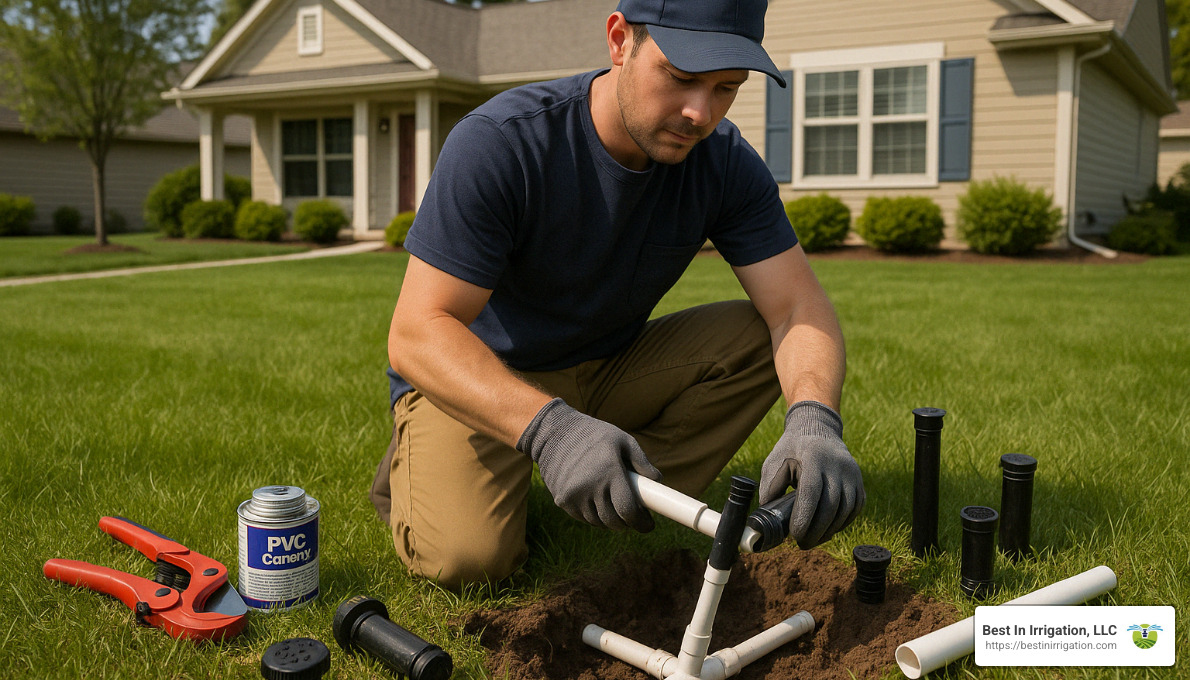
During pipe assembly, cut your pipes to the required lengths and start with the main supply line before connecting the lateral lines according to your design. For subsurface drip irrigation, place driplines with emitters facing upward to prevent clogging. Use appropriate connectors and check that everything fits snugly—a loose connection underground means a big headache later!
The component installation stage is where your system really takes shape. Install the backflow preventer at your water source (this is non-negotiable for safety), connect the controller in a protected location, and place valves according to your zone design. For sprinkler systems, install heads after your lines are in place, and don’t forget to add flush valves at the ends of lines for maintenance.
Before backfilling, test your system to catch any problems while they’re still easily accessible. Once everything checks out, carefully cover your components with soil, tamping gently to prevent settling without damaging anything. Replace the turf you removed and give everything a good watering to help it recover from the disruption.
Finally, conduct thorough testing and adjustments. Run each zone to verify proper operation, check for leaks or pressure issues, and adjust sprinkler heads or emitter flow as needed. Program your controller with appropriate schedules based on your lawn’s needs and local watering restrictions.

As one irrigation expert wisely puts it, “Dig a hundred dollar hole for a ten dollar plant.” This advice highlights something crucial about irrigation installation—the quality of your preparation and installation work far outweighs the cost of the components themselves. Taking shortcuts during installation often creates problems that become exponentially more difficult to fix once everything is buried.
When to Hire a Professional
While there’s satisfaction in DIY projects, some situations call for professional installation of an underground grass watering system. Recognizing these scenarios can save you time, money, and frustration in the long run.
If you have complex lawn layouts with multiple elevations, irregular shapes, or numerous obstacles like trees and hardscaping, professional design and installation makes sense. Our experts at Best In Irrigation can create custom zoning solutions that ensure even coverage despite these challenges, something that’s difficult to achieve without specialized knowledge.
Challenging soil conditions are another red flag for DIY installation. Rocky soil, high clay content, or compacted ground can turn a weekend project into a weeks-long battle. We have specialized equipment and techniques to address these challenges efficiently, saving your back and your sanity.
For large properties, professional installation is often the way to go. Extensive lawns require careful planning to ensure adequate water pressure throughout the system. Without proper pipe sizing and zoning, you might end up with areas that are overwatered while others remain parched. Our team knows how to maintain consistent performance across even the largest Massachusetts properties.
If you’re facing time constraints, consider that a professional team can typically complete an installation in a fraction of the time it would take most homeowners. What might be several weekends of your valuable time becomes a matter of days for our experienced crews. We pride ourselves on efficient installation that minimizes disruption to your landscape and your life.
The warranty benefits of professional installation shouldn’t be overlooked. DIY projects are entirely on you if something goes wrong, but our installations include comprehensive warranty protection. This gives you peace of mind and long-term support for your investment.
Perhaps most importantly, professional installers bring technical expertise that’s hard to match. Our team has extensive knowledge of hydraulics, soil science, and irrigation technology. This expertise ensures that your system is optimized for your specific conditions, maximizing efficiency and performance while minimizing water waste.
The Best In Irrigation, LLC difference comes from our 9 years of specialized experience in Massachusetts irrigation. We understand the local soil conditions and climate patterns that affect irrigation performance. We integrate cutting-edge technology for optimal water conservation, pay meticulous attention to detail during installation, and provide comprehensive post-installation support and maintenance services.
When you choose professional installation, you’re not just paying for someone to dig trenches and lay pipes—you’re investing in expertise, efficiency, and long-term system performance that will keep your lawn lush and your water bills manageable for years to come.
Maintenance and Troubleshooting of Underground Grass Watering Systems
Your underground grass watering system is a valuable investment that deserves proper care to keep it running smoothly year after year. Like any sophisticated system, regular maintenance isn’t just recommended—it’s essential for optimal performance and longevity.
Here in Massachusetts, our distinct seasons create unique challenges for irrigation systems. During spring, your system needs gradual awakening after winter dormancy. Summer demands consistent performance during peak growing season. Fall requires preparation for the coming cold, and winter necessitates complete protection from freezing temperatures that could crack pipes and damage components.
“I’ve seen $10,000 systems ruined by skipping a simple $150 winterization,” shares one of our senior technicians at Best In Irrigation. “Preventative maintenance isn’t just smart—it’s the difference between a system that lasts 20 years and one that fails after just a few seasons.”
Regular inspections help catch small issues before they become expensive problems. Walking your property regularly to check for unusually wet spots (potential leaks) or dry patches (possible clogged emitters) can save you significant headaches down the road. Modern smart controllers add another layer of protection by alerting you to unusual water usage patterns that might indicate problems.
For subsurface drip systems, periodic flushing is particularly important. These systems include flush valves for a reason—they help clear sediment and prevent clogs that could compromise water delivery. A quick seasonal flush takes just minutes but can extend your system’s life by years.
At Best In Irrigation, LLC, we understand that not everyone wants to handle maintenance themselves. That’s why we offer comprehensive service packages custom to Massachusetts properties, from basic seasonal check-ups to complete maintenance programs that give you total peace of mind. For those who prefer the DIY approach, we provide guidance on In-Ground Sprinkler System Repair and preventive maintenance practices.
Common Problems and Solutions
Even well-maintained underground grass watering systems occasionally encounter issues. Knowing how to identify and address these common problems will help keep your lawn lush and your water bills reasonable:
Root Intrusion can be a silent system killer. When grass and plant roots seek out water sources, they can grow into emitters and drip lines, causing blockages. You might notice decreased water flow or mysterious dry patches appearing in your otherwise healthy lawn. Modern tubing with Copper Shield™ Technology creates a natural barrier that discourages root intrusion. For existing systems, chemical root barriers can help, and in severe cases, affected sections may need replacement.
Clogged Emitters frequently cause uneven watering patterns. Massachusetts water often contains minerals and sediment that can accumulate over time. Regular system flushing is your first line of defense, along with proper filtration maintenance. Self-cleaning emitters are worth the investment for areas with known water quality issues.
Pressure Fluctuations can undermine even the best-designed systems. If you notice inconsistent coverage or poor sprinkler performance, check for pressure issues. Installing pressure regulators helps maintain optimal operation, while proper zone design ensures adequate pressure throughout your system.
Controller Malfunctions might leave you scratching your head when your system runs at 3 a.m. instead of 6 a.m.—or doesn’t run at all. First, verify the power source and check for simple issues like incorrect programming. For smart controllers, firmware updates might resolve quirky behavior. If problems persist, replacement may be necessary.
Broken Pipes or Connections often announce themselves with suddenly soggy spots in your lawn or unexplained jumps in your water bill. The repair process involves carefully locating the leak (look for unusually green or wet areas), gentle excavation to expose the damaged section, and repair or replacement of affected components.
Winter Damage is particularly relevant for Massachusetts homeowners. The freeze-thaw cycles in our region can be brutal on irrigation systems. Proper winterization before the first freeze is essential, and a thorough spring inspection helps identify and address any damage before you need your system up and running.
“An ounce of prevention is worth a gallon of repair,” jokes our maintenance leader. “The systems that need the fewest repairs are the ones that receive the most consistent care.”
Seasonal Maintenance Schedule
Maintaining your underground grass watering system requires a rhythm that follows the changing seasons. Here’s how to keep your system performing beautifully throughout the Massachusetts year:
Spring Inspection (March-April)
As temperatures warm and frost risk diminishes, it’s time to wake up your irrigation system. This process should be gradual to prevent damage. Begin by slowly restoring water to the system rather than suddenly opening valves fully. This prevents pressure surges that could crack pipes or fittings.
Carefully inspect for any winter damage, paying special attention to exposed components that might have cracked in freezing temperatures. Clean or replace filters and check each emitter for proper operation. This is also the perfect time to adjust your controller for spring watering needs and calibrate any environmental sensors.
“Spring startup is like a physical exam for your irrigation system,” explains one of our team members. “It’s when we catch little issues before they become big problems during the peak watering season.”
Summer Monitoring (May-August)
During the growing season, your system works hardest and deserves the closest attention. Monthly inspections ensure everything continues running smoothly. Watch for signs of stress in your lawn—yellowing patches might indicate clogged emitters or poor coverage.
Summer is also when water conservation becomes most critical. Adjust your watering schedule based on rainfall and temperature, taking advantage of any smart controller features that can automatically respond to weather conditions. Check your water usage regularly—unexpected increases often signal leaks that need attention.
Fall Winterization (September-November)
As temperatures cool, begin reducing watering frequency and duration. But the most crucial fall task for Massachusetts homeowners is thorough winterization. This process must be completed before the first hard freeze to prevent expensive damage.
Professional winterization typically involves using compressed air to blow all water out of the system—a process that requires specialized equipment and expertise. After blowing out the lines, shut off the water supply to the irrigation system and protect controllers and other components according to manufacturer recommendations.
“Skip winterization in New England? Might as well set your money on fire,” warns one of our winterization specialists. “I’ve seen entire systems destroyed by a single harsh freeze.”
Winter Protection (December-February)
Even during dormancy, your irrigation system needs some attention. Keep snow cleared from above-ground components and avoid piling snow containing road salt near system parts, as salt can cause corrosion over time.
Winter is also the ideal time to plan for system upgrades or modifications. Review your water usage data from the previous season to identify opportunities for improved efficiency. Consider whether newer technologies like soil moisture sensors or weather-responsive controllers might improve your system’s performance.
System Upgrades (As Needed)
Irrigation technology continually advances, offering new ways to save water while improving lawn health. Consider upgrading older components to more efficient models, expanding zones to accommodate landscape changes, or integrating water-saving technologies as they become available.
At Best In Irrigation, LLC, we offer maintenance plans that cover these seasonal needs without you having to remember every detail. Our technicians bring specialized knowledge of Massachusetts conditions and equipment designed specifically for proper system care. For many homeowners, professional maintenance provides invaluable peace of mind—knowing their irrigation investment is protected by experts who understand the unique challenges of New England weather.
Frequently Asked Questions about Underground Grass Watering Systems
How much water can I save with an underground grass watering system?
When homeowners ask me about water savings, I’m always excited to share the impressive numbers. An underground grass watering system can be a game-changer for your water bill and environmental footprint.
Most of our Massachusetts customers see water savings between 50% and 90% compared to traditional watering methods. That’s not just a small improvement—it’s a dramatic reduction that you’ll notice on your monthly bills.
The exact savings depend on several factors. Subsurface drip irrigation (SDI) systems typically achieve the highest efficiency, often reaching that impressive 70-90% savings mark. If you’re switching from hand watering or those old-fashioned above-ground sprinklers that spray water everywhere but where you need it, you’ll see the most dramatic improvements.
Your soil type matters too. Sandy soils might need different approaches than clay soils, which is why we carefully assess your property before installation. When we properly match the system to your soil conditions, you maximize every drop of water.
One study I often mention to customers found that subsurface systems are 70% more efficient than traditional sprinklers. Think about that—using less than one-third of the water to achieve the same or better results!
This efficiency is particularly valuable here in Massachusetts, where we often face seasonal water restrictions. Many of our clients tell us they’re able to maintain beautiful lawns even during restriction periods because their underground grass watering system uses water so efficiently.
The environmental benefits extend beyond your property line too. Less water usage means reduced energy consumption at municipal water treatment facilities—a small but meaningful contribution to our collective environmental efforts.
How deep should an underground grass watering system be installed?
The “how deep” question is one I get all the time, and it’s an important one! The perfect depth for your underground grass watering system depends on several key factors.
For subsurface drip irrigation (SDI), which is our most water-efficient option, we typically install the system between 6-12 inches below the surface. For most lawns, we target the 4-6 inch range, as this perfectly reaches the root zone where your grass can best absorb the moisture.
Your soil type plays a big role in determining the ideal depth. If you have sandy soil (common in some parts of Massachusetts), we might install the system a bit shallower—around 4-8 inches—because water moves downward more quickly in sandy soil. For clay-heavy soils, we often go deeper (8-12 inches) to encourage deeper root growth and better drought resistance.
For traditional in-ground sprinkler systems, the depths are different. Main water lines typically go 12-18 inches deep to protect them from freezing, while lateral lines usually sit at 8-12 inches. Sprinkler heads, of course, are installed flush with the soil surface so they can pop up when activated.
Here in Massachusetts, freeze protection is a major concern. Main water lines that stay pressurized year-round need to be below the frost line, which in our region can be 36-48 inches deep. That’s one reason why proper winterization is so important for irrigation systems in our climate.
As one of our irrigation technicians likes to say, “The ideal depth puts water where the roots can drink it up, not where the sun can steal it.” That perfectly captures our approach—targeting the active root zone (usually the top 6-8 inches for most lawn grasses) while avoiding surface evaporation.
When we assess your property, we’ll carefully evaluate your soil conditions and grass type to determine the perfect installation depth for maximum efficiency and lawn health.
What is the lifespan of an underground grass watering system?
Good news—a quality underground grass watering system is a long-term investment that can serve your property for many years when properly installed and maintained.
The lifespan of your system depends largely on the quality of components used. Premium systems featuring copper-shielded tubing, brass valves, and professional-grade controllers typically last 15-25 years or more. These are the systems we most often recommend to our Massachusetts customers who want long-term reliability.
Mid-range systems using standard components can still provide 10-15 years of dependable service with proper care. Even budget-friendly systems can last 5-10 years, though they may require more frequent repairs in later years.
Installation quality makes an enormous difference in system longevity. I’ve seen DIY systems fail within a year or two due to improper installation, while professionally installed systems continue performing beautifully for decades. At Best In Irrigation, LLC, our meticulous installation standards ensure proper depth, secure connections, and appropriate protection that maximize your system’s lifespan.
Regular maintenance is perhaps the biggest factor in extending system life. Annual inspections, proper winterization (absolutely essential in our Massachusetts climate), prompt repairs of minor issues, and periodic updates all contribute to a longer-lasting system. It’s like regular oil changes for your car—a little preventive care goes a long way.
Most quality systems come with tiered warranty coverage: typically 1-2 years for labor, 2-5 years for parts and components, with some premium components carrying lifetime warranties against manufacturing defects. At Best In Irrigation, LLC, we stand behind our Irrigation System Installation with comprehensive warranty protection.
Here’s something many homeowners don’t realize: even as systems age, they rarely need complete replacement all at once. Strategic upgrades to controllers, valves, or emitters can breathe new life into an older system, improving efficiency while extending its useful life.
In our 9 years of experience serving Massachusetts properties, we’ve found that the systems we install typically exceed industry average lifespans. It’s not uncommon for us to service systems we installed in our early days that are still performing beautifully—a testament to quality components and proper installation techniques.
Conclusion: Making the Right Choice for Your Lawn
After exploring the ins and outs of underground grass watering systems, you’re now equipped to make an informed decision about what might work best for your Massachusetts property. Finding the right system isn’t just about having a prettier lawn—it’s an investment in both your landscape’s beauty and environmental sustainability.
The perfect system for your lawn depends on several factors unique to your property. Your soil type plays a huge role—sandy soils drain differently than clay, affecting how water moves through the ground. The size and shape of your lawn matters too—larger properties might benefit from different solutions than compact yards with irregular shapes. And of course, your water availability and budget considerations will guide your final choice.
What works beautifully for your neighbor might not be ideal for your yard. That’s why customized solutions are so valuable when it comes to underground irrigation. Cookie-cutter approaches rarely deliver the best results when every landscape has its own personality and needs.
At Best In Irrigation, LLC, we bring 9 years of specialized experience working with Massachusetts properties to every project we undertake. Our approach combines technical know-how with a genuine passion for water conservation and customer satisfaction. We’ve weathered enough New England winters and summers to understand the unique challenges our climate presents, allowing us to design systems that perform beautifully season after season.
You might be leaning toward a subsurface drip system for its incredible water efficiency, or perhaps an in-ground sprinkler system makes more sense for your broad, open lawn. Maybe a hybrid approach that combines multiple technologies will give you the best of all worlds. Whatever direction you’re considering, making an informed decision based on your specific needs is the key to long-term satisfaction.
An underground grass watering system delivers benefits that go far beyond convenience. It’s a long-term investment that improves your property’s value, improves its appearance, and reduces your environmental footprint. With proper installation and regular maintenance, you’re setting yourself up for years of efficient, effective lawn irrigation that works quietly beneath the surface while your grass thrives above.
We’d love to help you explore your options and find the perfect underground watering solution for your unique property. Contact us at Best In Irrigation, LLC to discuss how we can transform your approach to lawn care with a system that’s truly rooted in efficiency—and designed specifically for your Massachusetts home.
