


Why Low Voltage Landscape Lighting is Perfect for Your Massachusetts Home
Low voltage landscape lighting transforms your outdoor spaces using safe 12-volt power instead of dangerous 120-volt household current. This approach to illuminating your property has become the gold standard for residential applications across Massachusetts, where homeowners demand both safety and stunning visual results.
Picture arriving home after a long day to find your landscape bathed in warm, welcoming light that guides you safely to your door while showcasing your property’s best features. That’s the magic of low voltage landscape lighting – it creates an atmosphere that’s both practical and enchanting, turning ordinary yards into extraordinary outdoor living spaces.
Key Benefits:
– Safety first – No risk of serious shock, even when wet
– Energy efficient – Uses up to 85% less power than traditional lighting
– DIY-friendly – No electrician needed for installation
– Expandable – Easy to add more lights later
– Long-lasting – LED fixtures last 10-15 years with minimal maintenance
– Weather resistant – Built to withstand New England’s challenging climate
– Property value boost – Professional lighting increases curb appeal and home value
– Versatile design options – Hundreds of fixture styles and beam patterns available
Popular Low Voltage Lighting Types:
– Path lights for walkways and driveways that provide safe navigation
– Spotlights for trees and architectural features that create dramatic focal points
– Flood lights for security and wide area coverage that deter intruders
– Well lights for uplighting from ground level that highlight landscaping
– Step and deck lights for safety on liftd surfaces
– Hardscape lights for retaining walls and outdoor kitchen areas
– String lights for entertaining spaces that create festive atmospheres
When the sun sets over Massachusetts, your outdoor space shouldn’t fade into darkness. Low voltage systems operate at just 12 volts – safe enough for children and pets to play around, yet powerful enough to create stunning nighttime ambiance that rivals professional installations. This gentle voltage eliminates the fear factor that keeps many homeowners from tackling outdoor electrical projects themselves.
The magic happens through a transformer that steps down your home’s 120-volt power to safe 12 volts. This simple device, typically mounted near your electrical panel or outdoor outlet, serves as the command center for your entire lighting system. Modern transformers include sophisticated features like multiple voltage taps, built-in timers, and even WiFi connectivity for smartphone control.
Unlike traditional line voltage systems that require expensive electrician installation, buried conduit, and local permits, LED landscape lights can save up to 85% in energy costs compared to traditional lighting while lasting decades longer. This dramatic efficiency improvement means your monthly electric bill barely notices the addition of comprehensive landscape lighting, making it an affordable luxury that pays for itself over time.
The environmental benefits extend beyond just energy savings. LED fixtures contain no mercury or other hazardous materials, and their extended lifespan means fewer fixtures ending up in landfills. For environmentally conscious Massachusetts homeowners, low voltage landscape lighting represents a responsible choice that doesn’t compromise on performance or beauty.
Whether you want to highlight your prize rose garden, light a pathway for safety, create a resort-like backyard atmosphere, or improve security around your property, low voltage lighting delivers professional results at DIY-friendly prices. The modular nature of these systems means you can start small with basic path lighting and gradually expand to create elaborate lighting schemes that would make landscape architects jealous.
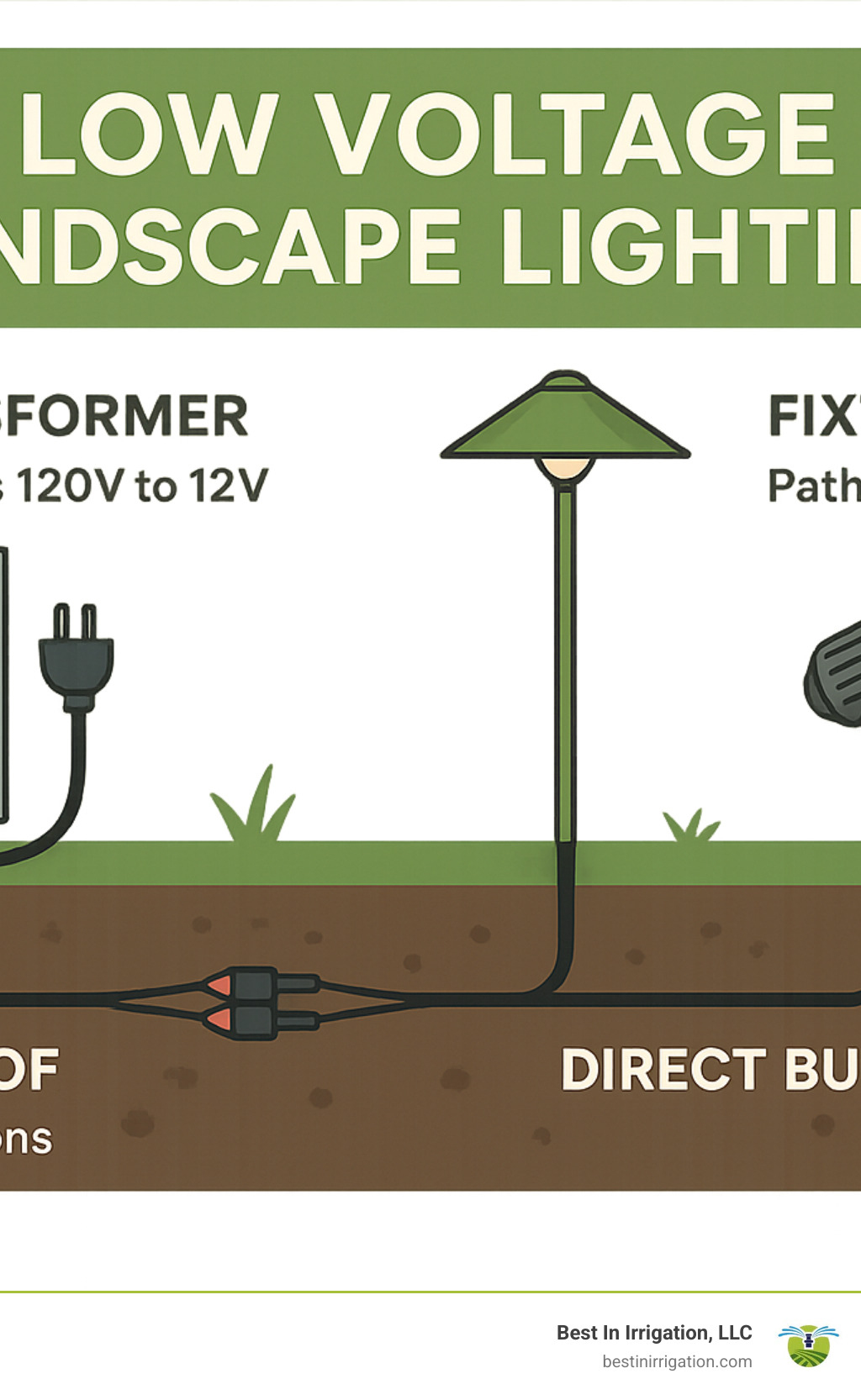
Low voltage landscape lighting terms simplified:
– what is the best wattage for landscape lighting
– what gauge wire is best for landscape lighting
– best landscape lighting transformer
What You’ll Learn
In this comprehensive product roundup, we’ll guide you through the best low voltage landscape lighting solutions specifically for residential properties throughout Massachusetts and New England. You’ll find which fixtures work best for different applications, how to power and wire your system safely without professional help, and professional design tips that make your outdoor spaces shine like those featured in home and garden magazines.
Our focus remains on practical, DIY-friendly solutions that improve your home’s beauty, safety, and security while respecting your budget and timeline. We’ll cover everything from basic starter kits perfect for first-time installers to advanced smart lighting systems that integrate with your home automation setup. By the end of this guide, you’ll have the confidence and knowledge to create a lighting system that transforms your property into the neighborhood showpiece.
Low Voltage Landscape Lighting 101: Benefits & Comparisons
Low-voltage systems run on safe 12-volt current instead of the 120-volt power inside your home. A small transformer steps the voltage down, letting most homeowners install lighting with basic DIY skills and no permits.
Why 12 V beats 120 V for Massachusetts yards
– Shock risk is virtually eliminated, even when fixtures get wet.
– LED lamps use about 75 % less power than old incandescent bulbs, trimming utility bills.
– Cable can be buried just a few inches deep with no rigid conduit.
– Fixtures are smaller, more decorative, and simple to reposition or add later.
| Feature | 12 V Low Voltage | 120 V Line Voltage |
|---|---|---|
| Safety | Minimal shock hazard | Serious shock hazard |
| Installation | DIY-friendly | Licensed electrician |
| Cable burial | 2-3 in. without conduit | 18 in. plus conduit |
| Energy use | 75 % less with LEDs | Standard consumption |
| Permits | Not required | Often required |
Modern transformers add photocells, timers or even Wi-Fi so you can schedule and dim lights from your phone.
Homeowner Priorities
- Family & pet safety: 12 V won’t hurt a child digging in the mulch or a dog that chews a wire.
- Lower energy bills: A typical front-yard system with LEDs can draw less wattage than two indoor bulbs.
- Easy expansion: Leave spare transformer capacity and you can snap new fixtures onto existing cable whenever your landscape evolves.
For best-practice wiring advice, see the Department of Energy’s outdoor lighting tips and the Electrical Safety Foundation’s guidance on transformer sizing.
Best Low Voltage Landscape Lighting Fixtures Roundup
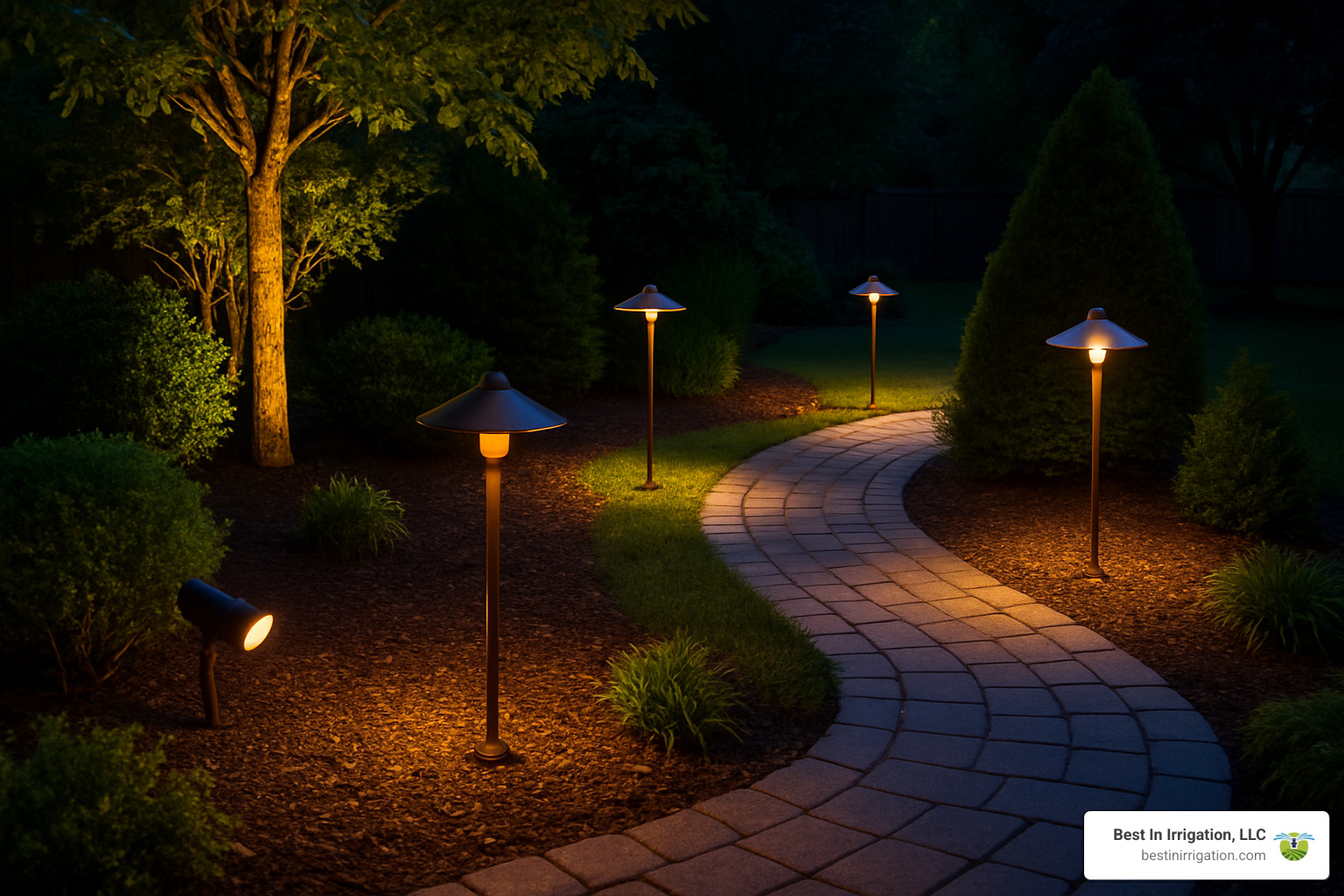
Matching each fixture to its job is the secret to a professional look.
Essential fixture types
– Path lights (50-200 lumens) guide guests along walks and drives.
– Spotlights (adjustable MR16 or PAR36) create drama on trees, statues or stonework.
– Flood lights (400-1000 lumens) add security to driveways or backyards.
– Well lights sit flush with the soil for unobtrusive uplighting.
– Deck/step lights (30-100 lumens) prevent nighttime tumbles on raised surfaces.
Color temperature shapes mood: warm 2700-3000 K feels welcoming, while cooler 4000 K is reserved for task or security zones.
Best Low Voltage Landscape Lighting for Paths & Walkways
Stagger fixtures on alternate sides every 8-12 ft. Overlapping pools of warm 2700 K light look natural and avoid the “runway” effect. Use glare-shielded heads so the LED source is never in direct view.
More ideas and product picks: Best Low Voltage Landscaping Lights.
Best Low Voltage Landscape Lighting for Accent & Uplighting
Position narrow-beam spots 3-6 ft from a tree trunk and aim 30-45°. Large specimens may need two or three fixtures for even coverage. Adjustable knuckle mounts let you tweak angles as plants mature.
Need inspiration? Browse our gallery of Best Landscape Lighting Ideas.
Budget-Friendly Low Voltage Landscape Lighting Kits
Starter kits bundle a transformer, cable and 6-12 fixtures. Quick-connect fittings pierce the main line—no stripping or wire nuts. Look for transformers with built-in timers, photocells or Wi-Fi. Explore high-efficiency options in our LED Outdoor Lighting guide.
Powering & Wiring Your System
The transformer is the system’s heart. Total your fixture wattage and add 20 % headroom. Example: 10 × 18 W path lights = 180 W × 1.2 = 216 W, so choose the next-size 300 W model to leave room for future lights.
Beat voltage drop with multi-tap transformers (12–15 V outputs) and the right wire gauge:
– 12-gauge for runs ≤ 100 ft & ≤ 200 W
– 10-gauge for anything longer/heavier
Two wiring layouts:
1. Hub – individual runs from a central point give uniform brightness.
2. Daisy chain – fixtures share one run; uses less wire but may need higher-volt taps at the far end.
Add a photocell or smart timer so the system operates automatically and only when needed. More detail: Best Landscape Lighting Transformer and What Gauge Wire is Best for Landscape Lighting?.
Safe Connections
Use silicone-gel-filled wire caps or waterproof splice boxes, and mount the transformer to a GFCI-protected outlet with an in-use cover. Bury cable about 6 in. deep to dodge lawn tools.
Plan for Expansion
Choose a transformer with at least 30 % spare capacity and run extra loops of cable to spots you may want to light later. Fixtures that accept standard MR16 or G4 LED lamps are easy to upgrade when brighter, more efficient bulbs appear.
Pro Design, Maintenance & Troubleshooting Tips
Layered lighting—path for background, spots for drama, floods for security—creates depth and avoids over-lighting.
Quick design math: space fixtures roughly equal to their beam diameter; shield or reposition any lamp where you can see the LED directly (glare test).
Stick to 2700-3000 K throughout for a cohesive residential feel. Use a multimeter once a year; readings below 10.8 V at a fixture signal a wiring upgrade or higher-volt tap.
Annual 30-minute check-up
1. Wipe lenses with mild soap.
2. Trim plants blocking beams.
3. Inspect and re-grease connections.
4. Realign fixtures that shifted during winter freeze-thaw.
Most quality LEDs give 10-15 years of service. When output dims noticeably, swap the lamp or integrated module.
For professional help, see our Landscape Lighting Installation page.
Frequently Asked Questions about Low Voltage Landscape Lighting
How long do LED low voltage landscape lights last?
Quality LED low voltage landscape lighting fixtures are built to last, typically running strong for 40,000-50,000 hours under normal conditions. When you break that down to real-world use – running your lights 8-10 hours each evening – you’re looking at 10-15 years of reliable performance before needing replacements.
That’s pretty impressive when you consider traditional incandescent bulbs burn out after just one or two seasons. The secret lies in LED technology’s efficiency and the gentler 12-volt power that doesn’t stress components like harsh line voltage systems do.
Professional-grade fixtures often come with lifetime warranties on the housing itself, plus 5-10 year coverage on the LED components. This reflects manufacturers’ confidence in the technology and gives you peace of mind about your investment.
Can I add more lights later without rewiring everything?
Absolutely! This flexibility represents one of the biggest advantages of low voltage landscape lighting systems. Unlike rigid line voltage installations that require major electrical work for changes, low voltage systems welcome expansion with open arms.
The key is having sufficient spare capacity in your transformer. If you planned ahead during installation (or got lucky with an oversized transformer), adding new fixtures is surprisingly simple. You can tap into existing cable runs using T-connectors or small junction boxes without disturbing your current setup.
Most homeowners find it wise to size their initial transformer with 20-30% extra capacity beyond current needs. This small upfront investment saves significant rewiring costs when you inevitably want to highlight that new garden bed or illuminate the back patio you added last summer.
What color temperature works best for residential gardens?
Warm white LEDs in the 2700-3000K range create the most welcoming residential lighting. This slightly amber tone mimics the cozy glow of traditional incandescent bulbs that feels natural and inviting around homes.
Think of it this way – cool white lighting belongs in parking lots and office buildings, not around your beautiful garden. The warm tones complement both your home’s architecture and the natural colors of plants and hardscaping materials.
For specific task lighting applications where you need crystal-clear visibility – like illuminating house numbers or security cameras – you might consider slightly cooler 3000-4000K temperatures. But for general landscape ambiance, stick with the warmer end of the spectrum. Your evening gatherings will feel more intimate, and your landscape features will look their absolute best.
Conclusion & Next Steps
Your journey into low voltage landscape lighting opens up a world of possibilities for changing your Massachusetts home’s outdoor spaces. These 12-volt systems deliver that perfect sweet spot where safety meets stunning visual impact – creating landscapes that welcome guests while keeping your family secure.
Think about it: you can now illuminate your favorite garden features, guide visitors safely along pathways, and add that resort-like ambiance to your backyard, all while using 75% less energy than traditional lighting. The LED fixtures we’ve explored will faithfully serve your property for 10-15 years, quietly doing their job night after night with barely any maintenance required.
The beauty of low voltage systems lies in their forgiving nature. Made a mistake with fixture placement? No problem – simply unplug and relocate. Want to add more lights next spring when the budget allows? Easy – just tap into your existing cables with simple connectors. This flexibility means your lighting can evolve with your landscape and lifestyle.
Most homeowners find they can install a complete starter system over a weekend using the plug-and-play kits and modular fixtures we’ve covered. The 12-volt power means no scary electrical work, no permits, and no expensive electrician visits. Just thoughtful planning, some basic digging, and the satisfaction of creating something beautiful with your own hands.
The layered approach we’ve discussed – combining path lights, accent spots, and security floods – creates that professional look that makes neighbors stop and admire. When you balance warm 2700K lighting with careful fixture placement, avoiding glare while highlighting your property’s best features, the results speak for themselves.
At Best In Irrigation, LLC, we’ve spent 9 years helping New England homeowners create outdoor spaces that truly shine. Our expertise in water-efficient irrigation naturally extends to energy-efficient lighting systems that complement your landscape investment. We understand Massachusetts weather, soil conditions, and the unique challenges of our region.
Your outdoor lighting project represents more than just fixtures and wires – it’s about creating spaces where memories happen. Whether you’re hosting summer barbecues, enjoying quiet evening conversations, or simply feeling secure as you arrive home after dark, the right lighting makes all the difference.
Ready to see your property in a whole new light? Our team at Best In Irrigation, LLC combines technical expertise with creative vision to design low voltage landscape lighting systems that exceed expectations. We’ll help you steer fixture selection, plan optimal placement, and ensure your system grows with your needs.
Visit our Landscape Lighting Installation page to start planning your lighting change today. Your Massachusetts landscape deserves to shine – let’s make it happen together.
