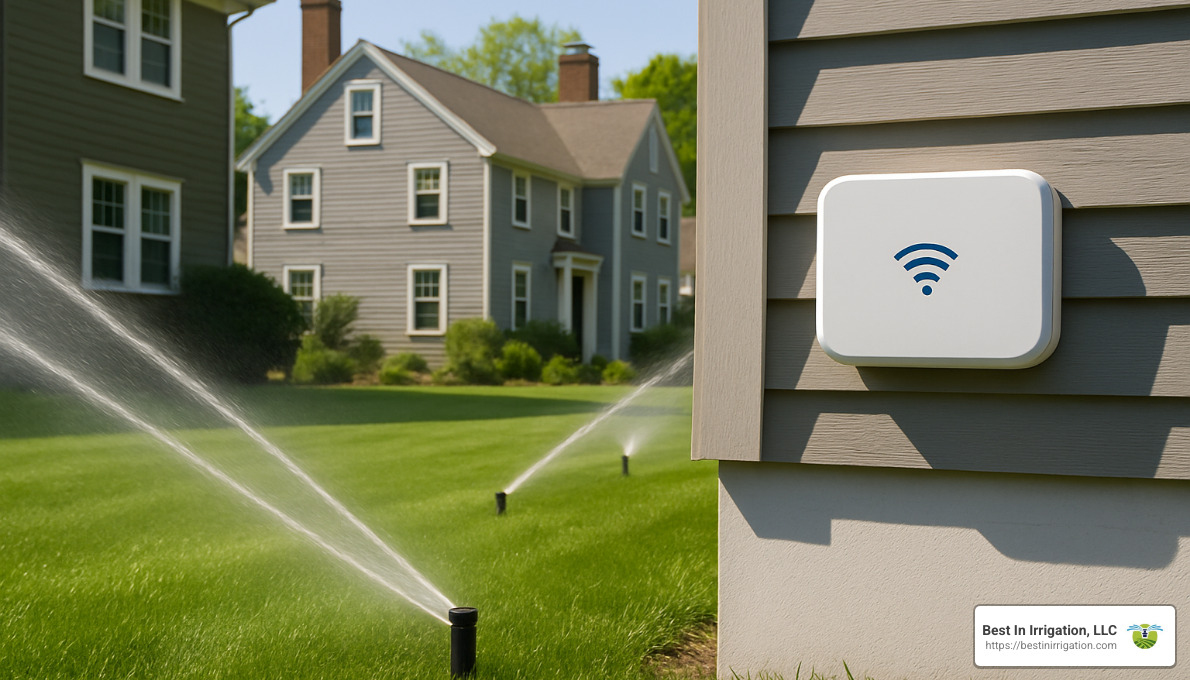

Smart Irrigation: Why You Need the Best Automatic Sprinkler Controller
Looking for the best automatic sprinkler controller to keep your Massachusetts lawn thriving while being water-smart? I’ve got you covered!
| Top Automatic Sprinkler Controllers (2025) |
|---|
| 1. Rachio 3 Smart Sprinkler Controller – Best overall with excellent weather integration |
| 2. Orbit B-hyve Smart Controller – Best value with robust features |
| 3. Rain Bird ST8-2.0 – Most reliable with excellent compatibility |
| 4. OpenSprinkler – Best for tech enthusiasts and customization |
| 5. RainMachine Touch HD – Best for privacy with local data storage |
Remember those frustrating moments watching your sprinklers run during a downpour? Or coming home from vacation to find your lawn either crispy-brown or soggy-green? Those days are over! The best automatic sprinkler controller transforms your basic irrigation system into a water-wise genius that knows exactly when and how much to water.
“Smart controllers make fine-tuned watering adjustments based on the robustness of their weather data,” explains Larry Ciufo from Consumer Reports. This weather intelligence is what truly separates today’s smart controllers from yesterday’s basic timers.
Did you know that according to the EPA, nearly half of all outdoor water ends up wasted due to inefficient irrigation? That’s literally money flowing down the drain! Smart controllers tackle this problem head-on by automatically adjusting your watering schedule based on what’s actually happening in your neighborhood—not some pre-set program that ignores reality.
Most quality controllers today proudly wear the EPA WaterSense certification badge, proving they conserve water while keeping your landscape healthy. They connect to your home Wi-Fi, putting complete control at your fingertips through user-friendly smartphone apps. Imagine adjusting your sprinklers while sitting at your kid’s soccer game or getting alerts about potential leaks before they become disasters.
For us Massachusetts homeowners, these smart devices offer practical benefits beyond convenience. They help you easily comply with local watering restrictions during those summer drought periods, protect your system when temperatures drop toward freezing, and can even detect underground leaks before they create sinkholes in your yard or spike your water bill.
Whether you’re upgrading an aging system that’s seen better days or installing something brand new, choosing the right controller isn’t just about keeping up with technology—it’s about being a responsible homeowner who values both a beautiful lawn and environmental stewardship.
Essential best automatic sprinkler controller resources:
– Best Lawn Sprinkler Systems for complete system solutions
– Best lawn sprinkler system company to find trusted professionals
At Best In Irrigation, we’ve spent 9 years helping Massachusetts homeowners find the perfect balance between lush lawns and water conservation. A smart controller isn’t just a gadget—it’s peace of mind knowing your landscape is getting exactly what it needs, nothing more and nothing less.
What Is an Automatic Sprinkler Controller?
Ever wondered what’s actually running the show when your sprinklers pop up right on schedule? An automatic sprinkler controller is essentially the command center of your entire irrigation system—the brains behind those perfectly timed water displays keeping your Massachusetts lawn green and healthy.
Think of your controller as a sophisticated traffic director. It manages different “zones” in your yard—perhaps your front lawn needs more water than your shaded side yard, or your garden beds require gentler watering than your open lawn. Each zone connects to a specific valve that the controller opens and closes according to your programmed schedule.
“Traditional controllers were glorified timers—they’d run regardless of whether Mother Nature was already watering your lawn for free,” says Mike Johnson, our irrigation specialist at Best In Irrigation, LLC. “But the best automatic sprinkler controllers today are genuinely smart devices.”
These modern controllers have evolved dramatically from their simple timer ancestors. They now:
- Pull real-time weather data through your home’s WiFi connection
- Calculate something called evapotranspiration (ET)—a fancy term for how much water evaporates from your soil and transpires through your plants
- Make intelligent watering decisions based on rainfall predictions, temperature shifts, humidity levels, and even wind forecasts
- Offer user-friendly mobile apps that let you check or adjust your watering schedule from anywhere (perfect for when you’re on vacation and see rain in the forecast)
- Seamlessly integrate with your existing smart home ecosystem through Alexa, Google Home, and other platforms
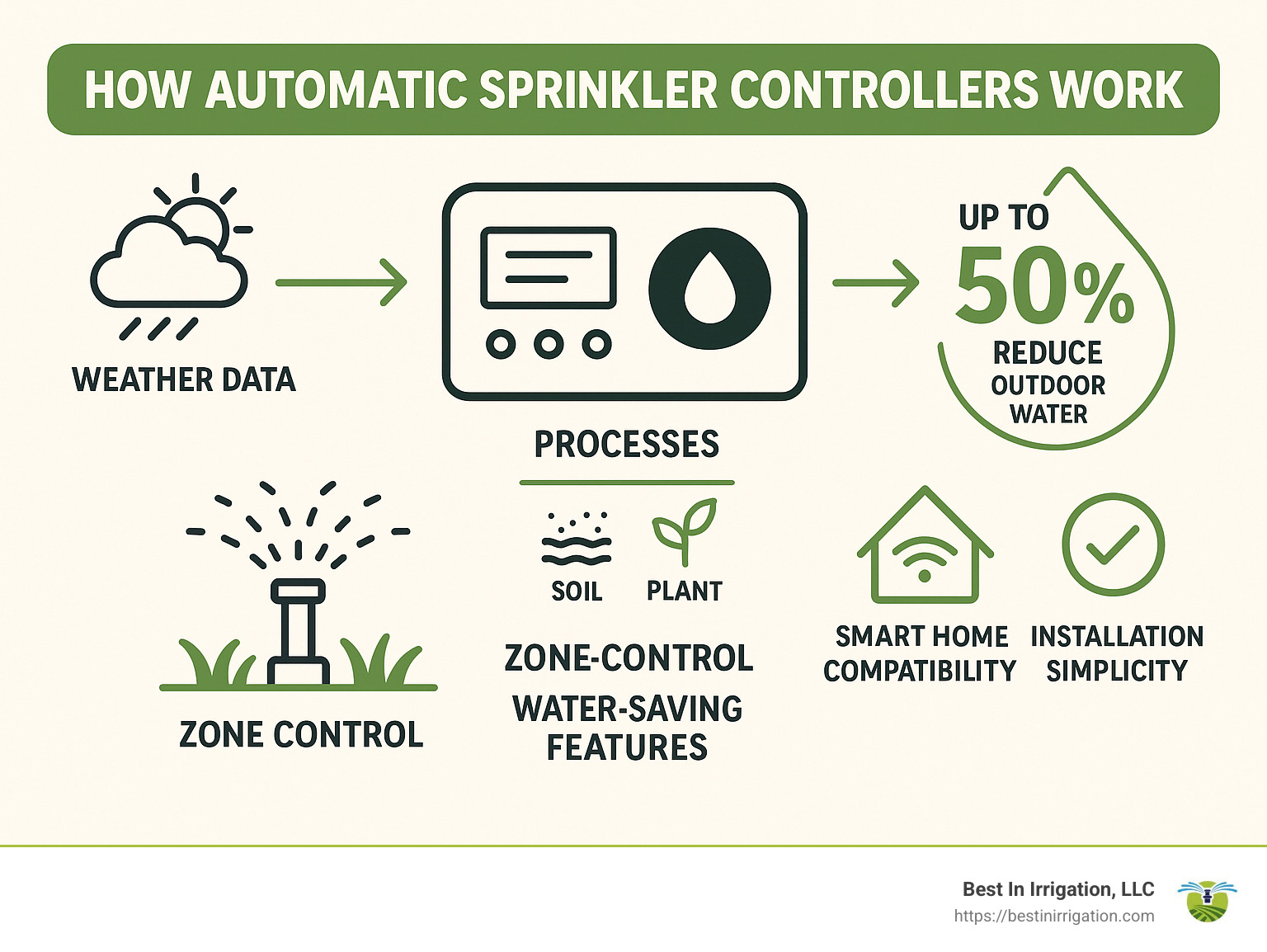
The science behind these smart controllers is impressive. According to EPA WaterSense research, controllers bearing their WaterSense label reduce water consumption by at least 20% compared to traditional timers. For the typical Massachusetts home, this translates to thousands of gallons saved annually—good for both your wallet and our local water resources.
What makes this technology truly remarkable is how it adapts to your specific landscape. Your controller’s app dashboard typically shows you exactly what’s happening with each zone, when adjustments are made due to weather, and how much water you’re saving compared to conventional timers.
The change from “dumb” timers to intelligent water management systems represents one of the most significant advances in home irrigation technology. Your sprinkler controller no longer just follows orders—it actively thinks about your lawn’s specific needs and responds accordingly.
Why Upgrade to the Best Automatic Sprinkler Controller?
Remember those Saturday mornings when you’d wake up to the sound of your sprinklers running—during a rainstorm? Or coming home from vacation to a brown, parched lawn because your timer kept the same schedule during a heatwave? Those frustrating days can be behind you with a modern automatic sprinkler controller.
Weather Intelligence
The best automatic sprinkler controllers today are like having a personal meteorologist dedicated to your lawn. They’re constantly analyzing weather patterns to make smart watering decisions:
“My smart controller saved my lawn last summer during that unexpected heat wave,” shares Mike from Framingham, one of our customers. “It automatically increased watering while I was away on business.”
These systems offer impressive weather-smart features like rain-skip functionality that cancels scheduled watering when rain is detected or forecasted. You’ll also appreciate freeze protection that prevents costly system damage by suspending irrigation when temperatures drop near freezing. And on those blustery Massachusetts days, wind detection postpones watering to prevent wasteful drift and uneven distribution.
Water Conservation
Did you know that nearly half of all outdoor water is simply wasted? The EPA estimates that up to 50 percent of water used outdoors is lost due to inefficient irrigation methods and systems. That’s literally money flowing down the drain!
Here in Massachusetts, where conservation matters more each year, a smart controller helps you be a good steward of resources while maintaining a beautiful landscape. These devices typically reduce unnecessary watering by 20-50%, helping you comply with local drought restrictions and odd/even day watering schedules that are becoming more common.
Plus, many local water utilities offer rebates and incentives for installing WaterSense-certified controllers—essentially paying you to save water. Check with your local water department to see what’s available in your area.
Remote Control and Monitoring
Remember when adjusting your sprinkler meant trudging out to the garage or basement? Those days are gone. Modern controllers connect to your home WiFi network, putting control literally in the palm of your hand:
“I was at my daughter’s soccer game when I got a weather alert,” explains Sarah from Newton. “I pulled out my phone and delayed watering with just a few taps—no mad dash home required.”
With a smartphone app, you can control your system from anywhere, receive alerts about potential issues, and make quick adjustments when weather patterns change. You can even share access with your landscape professional without giving them physical access to your home.
Smart Home Integration
If you’ve acceptd other smart home technology, your best automatic sprinkler controller will fit right in. Most premium models integrate seamlessly with popular platforms:
“Alexa, ask Rachio to water the front lawn for five minutes” is all it takes to give your flower beds a quick drink before guests arrive. These controllers work with Amazon Alexa, Google Assistant, and platforms like SmartThings to become part of your connected home ecosystem.
Tech-savvy homeowners can even create custom automations through IFTTT (If This Then That) to coordinate sprinklers with other smart devices or trigger special watering routines based on various conditions.
For more detailed information about creating an efficient watering system that works perfectly with these controllers, check out our guide to Efficient Lawn Irrigation Systems.
Choosing the Best Automatic Sprinkler Controller in 2025
Finding the perfect automatic sprinkler controller for your Massachusetts home doesn’t have to be overwhelming. Think of it as choosing a new smartphone – you want something reliable, easy to use, and packed with features that make your life easier.
Essential Features Checklist
When shopping for the best automatic sprinkler controller, start by counting your irrigation zones. Most residential systems in Massachusetts have between 4-16 zones, and you’ll want a controller that can handle all of them comfortably. Don’t forget to consider future expansion if you’re planning to add more garden beds or lawn areas down the road.
Weather integration is what truly separates smart controllers from basic timers. The more weather data sources your controller uses, the more accurately it can adjust your watering schedule. This is especially important in New England, where we can experience four seasons in a single week!
“The controller’s WiFi capabilities are crucial for reliable performance,” explains our senior technician at Best In Irrigation. “While most controllers connect to 2.4GHz networks, dual-band models that also support 5GHz provide better flexibility, especially in homes with many connected devices.”
Before making your final decision, take a moment to check the mobile app ratings in your app store. A great controller paired with a clunky app can lead to frustration. Similarly, verify that the controller works with your existing smart home setup, whether you’re an Alexa enthusiast or a Google Home devotee.
For outdoor installation, make sure your chosen controller has proper weatherproofing. And don’t overlook that EPA WaterSense certification – it’s your assurance that the device meets strict water efficiency standards.
WiFi vs. Traditional Controllers
| Feature | WiFi Smart Controllers | Traditional Timer Controllers |
|---|---|---|
| Weather adaptation | Automatic adjustments based on forecast | Manual adjustments required |
| Remote access | Control from anywhere via smartphone | Physical access required |
| Water savings | 20-50% through smart scheduling | Minimal unless manually adjusted |
| Installation complexity | Similar to traditional + WiFi setup | Basic wiring only |
| Power outage handling | Cloud-stored schedules, some have battery backup | Often require reprogramming |
| Cost | Higher initial investment | Lower upfront cost |
| Long-term value | Higher due to water savings | Lower due to inefficient watering |
While traditional controllers might seem more budget-friendly initially, the water savings from a smart controller typically pays for itself within 1-2 watering seasons in Massachusetts. Plus, you can’t put a price on the peace of mind that comes from knowing your system won’t run during a rainstorm while you’re away on vacation.
How the best automatic sprinkler controller saves water
The water-saving magic of smart controllers happens behind the scenes through sophisticated algorithms. These systems create dynamic watering schedules that adjust automatically based on current and forecasted weather conditions. No more fixed Monday-Wednesday-Friday watering regardless of rainfall!
Best automatic sprinkler controllers also consider your specific soil type. Sandy soils in coastal Massachusetts areas need different watering patterns than the clay-heavy soils found in other regions. The controller adjusts water delivery based on how quickly your soil absorbs moisture, preventing both runoff and underwatering.
“Our customers are often surprised by how much smarter these controllers are than their old timers,” says Sarah Thompson from Best In Irrigation, LLC. “They’re not just saving water – their lawns actually look better because they’re receiving precisely the right amount of water at the right time.”
The smart cycle and soak feature is particularly valuable for properties with slopes or clay soil. Instead of delivering all the water at once (which can cause runoff), the controller breaks watering into shorter intervals, allowing time for absorption between cycles.
According to Consumer Reports testing, these intelligent features deliver at least 20% more efficient watering compared to traditional timers. For a typical Massachusetts home, this can mean savings of thousands of gallons each summer.
Installing the best automatic sprinkler controller step-by-step
Swapping out your old controller for a smart model is usually a straightforward weekend project. Here’s how to do it:
First, turn off power to your existing controller and take a photo of your current wiring setup – this will be your reference guide. Before disconnecting anything, label all wires with their zone numbers and identify the common wire (usually white).
Once everything is labeled, remove the old controller from the wall and mount your new smart controller in the same location. Connect each wire to its corresponding terminal, following the manufacturer’s guide and your reference photo.
After restoring power, it’s time for the fun part – connecting to WiFi and setting up your system through the app. You’ll create profiles for each zone, specifying details like soil type, plant type, sun exposure, and slope. Most apps will then recommend smart schedules based on these factors and your local weather patterns.
The whole process typically takes 30-45 minutes, and the results are immediate. For more detailed guidance on irrigation system installation, our How to Install a Lawn Sprinkler System guide covers everything you need to know.
1. Weather-Based Wi-Fi Controllers
Weather-based controllers are truly the crown jewels of irrigation technology. If you’re serious about water conservation without sacrificing your lawn’s health, these smart devices deliver the perfect balance of convenience and efficiency.
How They Work
Imagine having a personal meteorologist dedicated to your lawn’s specific needs. That’s essentially what these controllers provide! They connect to your home Wi-Fi to access hyper-local weather data that’s remarkably precise for your exact location.
“The weather in your neighborhood can be completely different from conditions just a mile away,” explains John from our Best In Irrigation team. “These controllers tap into that hyper-local data to make smart decisions about your lawn.”
The best automatic sprinkler controllers analyze multiple weather factors:
– Current and forecasted rainfall (so you’re never that neighbor watering during a downpour)
– Temperature fluctuations throughout the day
– Humidity levels that affect how quickly moisture evaporates
– Wind speed that can impact sprinkler coverage
– Solar radiation intensity
– Detailed evapotranspiration rates (the scientific measure of how much water your plants lose)
They then combine this weather intelligence with your specific landscape details—like whether you have clay soil that retains moisture or sandy soil that drains quickly, sun-loving perennials or shade-tolerant grass—to create truly customized watering schedules.
Key Advantages
The sophistication of these systems translates to impressive benefits. Most Massachusetts homeowners see water savings of 30-50% compared to traditional timers—that’s thousands of gallons saved every season!
These controllers offer true “set and forget” operation. Once properly configured, they make daily adjustments automatically. No more rushing out before vacation to adjust your timer or worrying about unexpected heat waves.
The comprehensive mobile apps provide detailed insights into your watering history, upcoming schedules, and potential savings. Many even generate monthly reports showing exactly how much water you’ve conserved.
Voice assistant integration means you can say “Alexa, skip tomorrow’s watering” or “Hey Google, water the front lawn for 5 minutes” without lifting a finger. Perfect for when you notice a dry spot while entertaining guests!
Best For
Weather-based controllers are perfect for Massachusetts homeowners who:
– Want the absolute most efficient watering possible
– Travel frequently and need reliable remote access
– Have varied landscape zones with different watering needs
– Appreciate smart home technology and seamless integration
“The ability of these smart sprinkler controllers to make fine-tuned watering adjustments greatly depends on the robustness of their weather data,” notes Consumer Reports. That’s why the best automatic sprinkler controllers use multiple weather sources rather than relying on a single data feed.
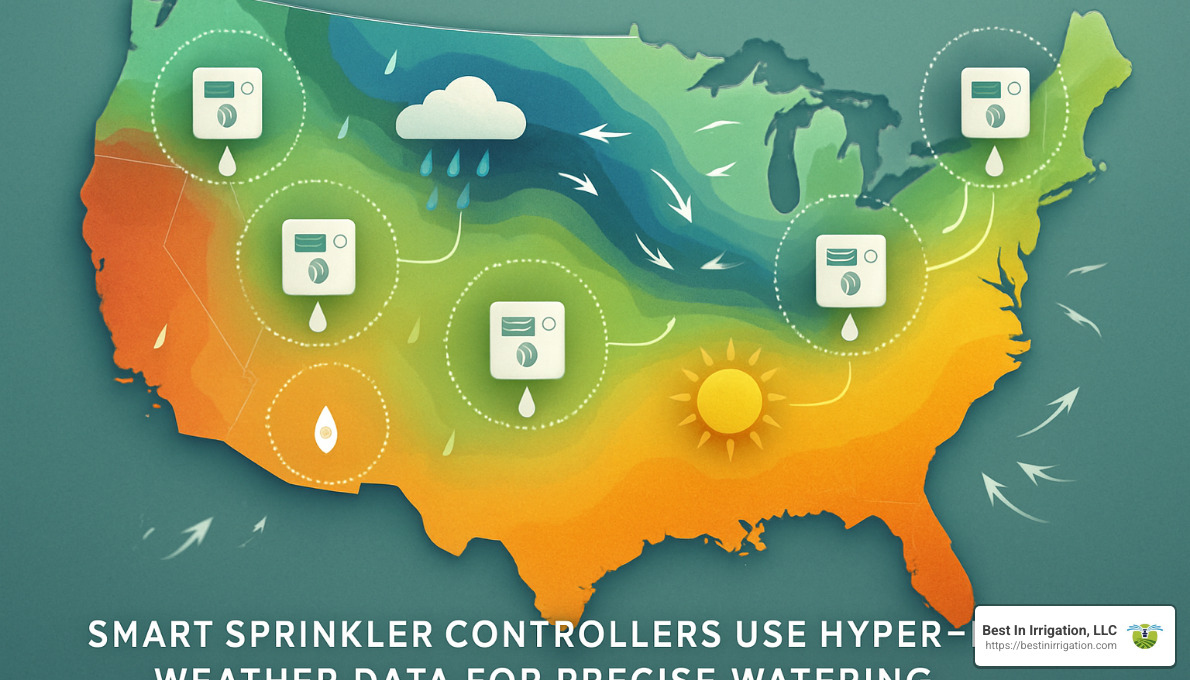
While these controllers represent a higher initial investment, our customers consistently tell us the water savings and convenience make them worth every penny. Plus, many Massachusetts water utilities offer rebates for WaterSense-certified smart controllers, making the upgrade even more attractive.
2. Sensor-Driven Soil Moisture Controllers
There’s something wonderfully straightforward about soil moisture controllers – they don’t guess about when to water, they actually know. While weather-based systems are looking at the sky, these smart devices are getting their hands dirty.
How They Work
These clever systems rely on in-ground moisture probes that you place strategically throughout your yard. Think of these probes as tiny underground spies reporting back with the real scoop on what’s happening beneath the surface. When your soil gets thirsty, they send a signal to your best automatic sprinkler controller, which then activates only the zones that need watering.
“What I love about soil moisture controllers is their simplicity – they measure what matters most: the actual water available to your plants’ roots,” explains Mike from Best In Irrigation, LLC. “It’s like having a direct line of communication with your soil.”
The beauty is in the precision. Once your soil reaches its ideal moisture level, the system automatically shuts off, even if the originally scheduled watering time hasn’t elapsed. No more guesswork, just perfect soil moisture levels all season long.
Key Advantages
These controllers offer unique benefits that make them perfect for many Massachusetts properties. Their zone-specific runtime capability means each area of your yard receives precisely the water it needs – no more, no less.
They’re particularly brilliant with cycle/soak functions, which prevent runoff by breaking watering into shorter intervals that allow water to penetrate deeply into the soil between cycles. For properties with drip compatibility needs, soil moisture controllers provide the gentle, precise control these systems require.
Many models proudly display the EPA WaterSense badge, confirming they meet strict water efficiency standards while maintaining healthy landscapes. Best of all, many soil moisture controllers don’t rely on internet connections to function properly, making them resilient during network outages.
Best For
You’ll likely love a soil moisture controller if your property has:
– Varied soil conditions across your yard
– Areas where weather forecasts don’t seem to match actual conditions
– Specialty gardens with plants that need precise moisture levels
– Spotty internet service that might disrupt a WiFi-dependent system
– Drip irrigation systems that require careful water management
“We installed soil moisture sensors for a client in Lexington whose property had everything from sandy soil near their driveway to heavy clay by their back fence,” shares Sarah from our installation team. “Their traditional controller was either drowning one area or leaving the other parched. The soil sensors solved that problem immediately.”
For Massachusetts homeowners dealing with our region’s unpredictable weather patterns, soil moisture controllers offer peace of mind that your irrigation system is responding to what’s actually happening underground, not what a weather algorithm predicts might happen.
3. Flow-Monitoring Controllers
Flow-monitoring controllers bring an extra layer of intelligence to your sprinkler system by keeping a watchful eye on the water flowing through your pipes—almost like having a personal plumbing guardian for your yard.
How They Work
These smart controllers connect to a flow meter that’s installed on your main irrigation line. Think of it as a fitness tracker for your sprinkler system. This meter constantly measures both the volume and rate of water passing through, allowing the controller to:
- Learn what “normal” flow looks like for each zone in your yard
- Spot when something doesn’t look right (like a sudden increase in water use)
- Keep detailed records of exactly how much water your lawn is drinking
Key Advantages
Leak detection might be the most valuable feature of these systems. When a sprinkler head gets knocked off by a lawnmower or an underground pipe cracks, your flow-monitoring controller notices the unusual water pattern immediately. Rather than waiting until you spot a soggy patch in your yard (or worse, receive a shocking water bill), you’ll get an alert right away.
Water usage tracking gives you precise information about your consumption down to the gallon. This is particularly helpful if you’re trying to stay within water restrictions or simply want to be more conservation-minded about your lawn care.
Automatic shutoff capabilities mean these controllers don’t just detect problems—they take action. If a significant leak is detected, the system can automatically shut down that zone or your entire system to prevent water waste and potential property damage.
High-pressure diagnostics help identify potential stress points in your system before they become actual breaks or leaks. This preventative approach can save you from more costly repairs down the road.
Freeze-break protection is especially valuable for Massachusetts homeowners. These controllers can detect the sudden flow changes that occur when pipes burst during freezing temperatures, potentially saving you from serious water damage.
“Flow meters can detect piping system leaks before visible lawn damage appears,” explains Mike from our team at Best In Irrigation. “We’ve had customers who were alerted to leaks while on vacation—saving them from coming home to flooded yards and massive water bills.”
Best For
Flow-monitoring controllers really shine for Massachusetts homeowners with larger properties where it’s harder to visually inspect the entire irrigation system regularly. They’re also perfect for vacation homes or properties that sit empty for periods of time.
If you live in an area prone to freezing temperatures (which definitely includes Massachusetts winters!), these controllers offer valuable protection against cold-weather pipe damage. They’re also ideal for homeowners who appreciate detailed data about their water usage or properties with older irrigation systems that might be more prone to leaks.
At Best In Irrigation, LLC, we’ve seen how flow monitoring has prevented major water damage for many of our Massachusetts customers. There’s real peace of mind knowing your system can detect and respond to problems even when you’re not home to notice them yourself.
4. Open-Source & DIY Controllers
For the tinkerers and tech enthusiasts among us, open-source and DIY controllers offer a playground of possibilities that commercial systems simply can’t match. These customizable options have gained quite a following among Massachusetts homeowners who love to roll up their sleeves and create something truly unique.
How They Work
At their heart, these systems typically run on accessible hardware platforms like Raspberry Pi or Arduino paired with community-developed software. The beauty is in the variety – you can opt for pre-built systems running open-source firmware or dive into completely DIY projects where you assemble everything yourself.
OpenSprinkler has emerged as the crowd favorite in this space, offering both ready-to-install units and DIY kits that let you customize to your heart’s content. I’ve seen some Massachusetts homeowners create truly impressive setups that perfectly match their specific irrigation needs.
“The community aspect is what makes these systems so special,” explains Mark from Best In Irrigation, LLC. “When someone figures out a clever solution for a unique irrigation challenge, they share it, and suddenly everyone benefits.”
Key Advantages
The freedom these systems provide is best by commercial alternatives. With an open-source controller, you get unlimited customization that lets you build exactly what you need. The expandability means you’re never locked into a specific number of zones – just add more as your landscape evolves.
The vibrant community support provides a wealth of knowledge through forums and continuous improvements to the software. Many of our customers love the seamless integration with home automation systems like Home Assistant, bringing their irrigation into their broader smart home ecosystem.
Perhaps surprisingly, these systems can be quite cost-effective for larger properties. While the initial setup might require more time investment, the savings can be substantial when you need to control many zones.
Customization Perks
The possibilities with open-source controllers go well beyond basic scheduling. Creative homeowners have used these platforms to:
- Design irrigation programs that respond to multiple environmental factors simultaneously
- Implement specialized soil sensors that provide granular data for different plant types
- Create custom mobile dashboards that display exactly the information they care about
- Connect to personal weather stations for hyper-local weather data
- Develop automation that integrates with other yard systems like outdoor lighting
Best For
Open-source controllers shine brightest for certain types of homeowners. They’re ideal for the tech-savvy enthusiast who enjoys tinkering with both hardware and software. If your property has unique irrigation requirements that commercial systems struggle with, a customized solution might be perfect.
They’re also excellent for those who want complete control over their data without relying on third-party cloud services. Homeowners already deep into comprehensive home automation find these systems integrate beautifully with their existing setup.
“I would look at OpenSprinkler for this,” recommends one forum user discussing advanced scheduling needs. “It offers maximum flexibility for complex watering scenarios.”
At Best In Irrigation, LLC, we’ve helped many Massachusetts homeowners implement these flexible systems, providing guidance on how to maximize their potential while ensuring reliable operation. The satisfaction of creating a system perfectly custom to your unique landscape is something many of our customers find deeply rewarding.
5. Hybrid Timer-Smart Controllers for Budget Upgrades
Not everyone is ready to dive headfirst into fully automated smart irrigation. That’s where hybrid controllers come in—they’re the perfect middle ground for Massachusetts homeowners who want some modern features without abandoning the familiar.
These controllers maintain the classic look and feel you’re probably used to, with physical dials and buttons that many of us find reassuring. But beneath that traditional exterior, they pack some seriously useful smart features that can help save water and simplify your lawn care routine.
“These controllers look like traditional sprinkler controllers but are plenty smart,” notes a Consumer Reports review. This familiar design makes them particularly appealing if you’re upgrading from an older system and don’t want to face a steep learning curve.
How They Work
Hybrid controllers give you the best of both worlds. You’ll find the traditional manual dial for selecting programs and a straightforward control panel with buttons for quick adjustments. But they also connect to your home WiFi, allowing basic remote control through simplified smartphone apps.
Most models include a rain-delay button right on the controller itself—perfect for those sudden Massachusetts thunderstorms when you need to quickly pause your watering schedule. The calendar view display makes it easy to visualize your watering days at a glance, something many fully digital controllers have moved away from.
Weather integration is typically more basic than premium models, often through optional rain sensors rather than comprehensive weather data. But this simplicity also means fewer connectivity issues and less frustration for those who aren’t tech enthusiasts.
Key Advantages
The best automatic sprinkler controller in this category offers several compelling benefits. First, they’re significantly more affordable than fully-featured smart controllers—often 30-50% less expensive. This makes them an excellent option if you’re on a tighter budget but still want some smart functionality.
Their familiar interface means you won’t need to rely entirely on apps for programming. When your phone battery dies or you simply prefer physical controls, you can make adjustments directly at the unit. This dual-control approach is particularly appreciated by many of our Massachusetts customers who may share lawn care responsibilities across generations.
Setup is typically more straightforward, with less complex WiFi configuration and account setup. Many models don’t require creating cloud accounts or linking multiple services, which simplifies the initial installation process considerably.
Perhaps most importantly, hybrid controllers offer a gradual learning curve. You can start with basic programming using the physical interface, then slowly explore the smart features as you become more comfortable. This step-by-step approach helps many homeowners ease into smart irrigation without feeling overwhelmed.
Best For
At Best In Irrigation, LLC, we often recommend hybrid controllers for specific situations. They’re perfect for homeowners working with tighter budgets who still want some modern conveniences. If you’re less comfortable with technology or prefer having physical backup controls, these controllers offer welcome reassurance.
They’re also ideal for simpler irrigation systems with fewer zones, where the advanced zone-specific customization of premium controllers might be overkill. In properties where WiFi connectivity is spotty or unreliable—which can happen in some parts of Massachusetts—these controllers continue functioning perfectly through their traditional programming.
Many of our older customers particularly appreciate having physical controls they can see and touch, while still gaining the benefits of occasional remote access through the app when needed.
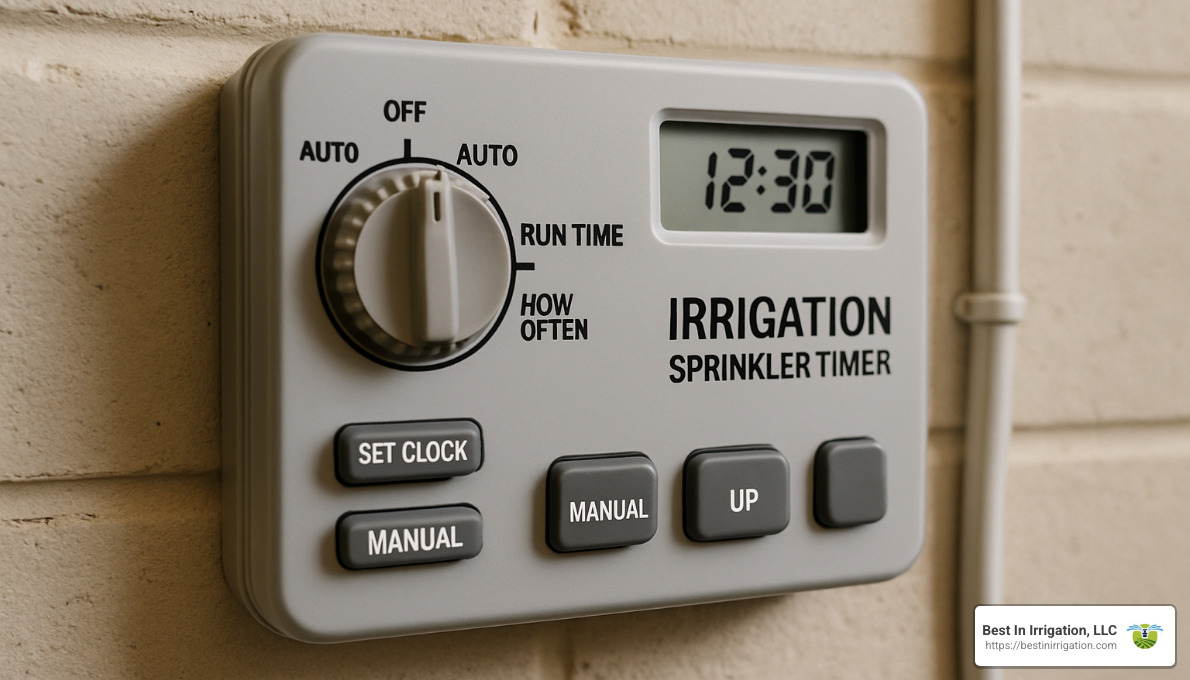
While these controllers may not offer all the bells and whistles of premium models, they provide a comfortable stepping stone into smart irrigation that many homeowners find just right for their needs and comfort level. They’re proof that you don’t need to go all-in on technology to start enjoying some meaningful benefits of modern irrigation control.
Frequently Asked Questions about Automatic Sprinkler Controllers
Do smart controllers comply with local watering restrictions?
Yes, the best automatic sprinkler controllers are built with compliance in mind. Here in Massachusetts, where water conservation is increasingly important, these smart devices can be your ally in following local regulations.
Most controllers let you easily program specific watering days (whether that’s odd/even dates or particular days of the week), set restricted hours (since many Massachusetts towns prohibit those midday waterings), and make seasonal adjustments during drought periods.
“What I love about the newer models is that some will actually import your local water restrictions automatically based on your ZIP code,” says Mike from Best In Irrigation, LLC. “It takes the guesswork out of staying compliant.”
When we install controllers for our Massachusetts customers, we always make sure they’re programmed to follow local water regulations from day one. It’s one less thing for you to worry about!
How many zones can I control without upgrading valves?
Good news for most homeowners – you can typically replace your controller without touching your existing valve system. Most residential controllers support between 4 and 16 zones, which covers the needs of typical Massachusetts properties.
The number of zones you can control depends on three main factors:
1. Your new controller’s zone capacity
2. Your existing valve configuration
3. The power requirements of your current valves
“I had a customer worried they’d need to dig up their whole yard to upgrade their controller,” laughs Sarah from our installation team. “They were relieved to learn we could simply swap out the controller while keeping all their existing valves in place.”
If you’re looking to expand beyond your current setup, many popular models offer expansion modules to add extra zones. Not sure about compatibility? We’re happy to take a quick look at your current system before you make a purchase.
Can I integrate my controller with Alexa or Google Home?
Yes, and it’s actually pretty fun to control your sprinklers with voice commands! Most of the premium smart controllers on the market now offer seamless integration with popular voice assistants.
Imagine saying, “Alexa, ask Rachio to water the flower beds for five minutes” while you’re cooking dinner, or “Hey Google, skip tomorrow’s watering schedule” when you hear rain in the forecast. These integrations make managing your irrigation system more convenient than ever.
The level of integration does vary between brands. Some controllers offer basic on/off functionality, while others provide detailed reporting and advanced commands. If you’re already invested in a smart home ecosystem, it’s worth checking the specific compatibility of any controller you’re considering.
“My favorite is asking Alexa when my next watering is scheduled,” shares one of our Massachusetts customers. “It’s perfect for planning outdoor activities or knowing when to expect the system to run.”
For Massachusetts homeowners who value both water conservation and modern convenience, these voice integrations represent the perfect blend of responsible resource management and cutting-edge technology.
Conclusion
The best automatic sprinkler controller truly revolutionizes how you care for your lawn. These smart devices don’t just operate on basic timers—they create personalized watering schedules based on weather patterns, soil conditions, and the specific needs of your landscape. The result? A lush, healthy yard that receives exactly the right amount of water, exactly when it needs it.
For Massachusetts homeowners, upgrading to a smart controller delivers benefits you’ll notice right away:
Your water bills will shrink as you save 20-50% on outdoor water usage. Your grass and plants will thrive with precise watering that prevents both drought stress and soggy soil. And you’ll enjoy the convenience of managing everything from your smartphone, whether you’re at work or on vacation.
“We’ve seen customers completely transform their relationship with lawn care after installing a smart controller,” says Mike from Best In Irrigation, LLC. “They’re amazed at how much easier it is to maintain a beautiful yard while using significantly less water.”
These controllers also help you stay compliant with Massachusetts water restrictions during dry periods—a feature that’s becoming increasingly valuable as our climate changes. Plus, the alert systems provide peace of mind by notifying you immediately about leaks or system issues before they cause damage.
At Best In Irrigation, LLC, we’ve spent 9 years helping Massachusetts homeowners steer the unique challenges of New England’s climate and soil conditions. We understand which controllers work best for different property types and can help you select the perfect option for your specific needs—whether you’re focused on maximum water savings, leak detection, or simple remote control.
The future of lawn care is water-smart, and these controllers are at the heart of that change. They simplify maintenance while conserving our precious water resources—a win for your wallet, your landscape, and the environment.
Ready to upgrade your irrigation system with the best automatic sprinkler controller? We’d love to help! Contact Best In Irrigation, LLC today for a friendly consultation. We’ll guide you through selection, handle the installation, and program your system for optimal performance.
For more information about comprehensive irrigation solutions that work perfectly with these controllers, check out our guide to best lawn sprinkler systems.